Supabase vs Firebase vs Postgres: Pricing and Platform Work
At 50K MAU, compare Supabase, Firebase, and plain Postgres by platform work, billing meters, failure modes, and when SQL control beats managed convenience.
Filed under Decision Guides· see every report on this topic
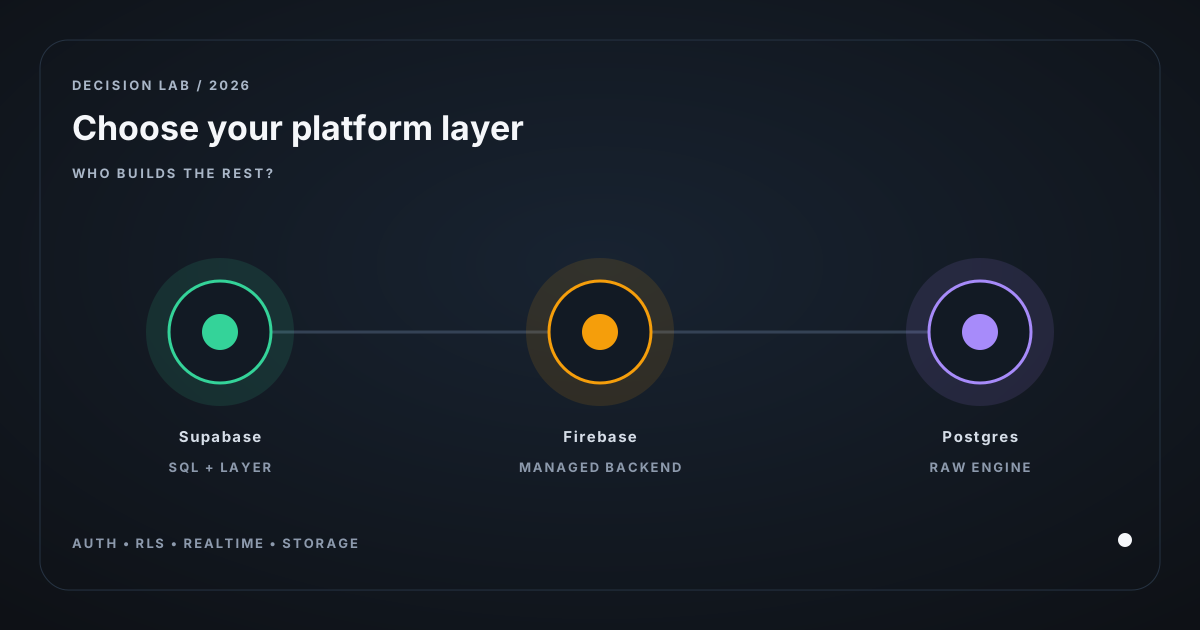
Verdict. Pick Supabase when you want Postgres and SQL with managed auth, RLS, realtime, storage, functions, backups, and logs. Pick Firebase when a managed backend and client-first realtime workflow matter more than SQL portability. Pick plain Postgres when the workload needs it and you will assemble auth, storage, realtime, observability, and operations. You are choosing how much platform work to own and which meter to watch.
This Workflow Decision Lab guide is for an indie builder who chooses on a free-tier logo, then finds they also need identities, files, backups, and alerts.
Proof status. Prices below come from vendor pricing pages as of 21 August 2026 and every figure links to its source. The worked example uses those published rates and shows its assumptions. Firebase’s fetched page sends paid Firestore pricing to Google Cloud pricing instead of giving a per-read rate, so that component is unverified, re-check before publishing. Pricing changes. Re-run the links before a year-long commitment.
The operator and the leak
You are building your fourth SaaS for 50K MAU. You need roles, social login, MFA, uploads, live screens, and reporting that will eventually use joins. You do not want to rebuild password reset or get a read-heavy bill you cannot explain.
What each platform leaves on your plate
Supabase is managed Postgres plus Auth, Storage, Edge Functions, Realtime, backups, logs, and a dashboard (Supabase pricing, as of 21 Aug 2026). Firebase includes Authentication, Firestore, Realtime Database, Functions, Storage, and Hosting (Firebase pricing, as of 21 Aug 2026). Plain Postgres supplies the engine; you make the adjacent product choices.
| Capability | Supabase | Firebase | Plain Postgres |
|---|---|---|---|
| Auth | Auth; configure providers, policies, email/SMS delivery | Authentication; configure providers and client flows | Choose or build auth; own session and identity integration |
| RLS / security rules | PostgreSQL RLS; write and test policy | Security Rules and custom claims; write and test rules | Design and test authorization in API/database |
| Realtime | Postgres changes, Broadcast, or Presence | Firestore/Realtime Database subscriptions | Build or buy WebSockets/SSE, propagation, fan-out, backpressure |
| File storage | Storage and access controls | Cloud Storage for Firebase | Choose storage, signed URLs, lifecycle, CDN, access control |
| Migrations | SQL migrations/CLI and Postgres schema | Model and rules deployments; no relational Firestore SQL path | Run migration tool, review rollouts, recover failures |
| Observability | Dashboard/logs; Pro has 7-day log retention | Firebase/Google Cloud tools; configure needs | Pick and wire logs, metrics, tracing, alerts |
| Backups | Managed backups; Pro daily backups retained 7 days | Managed durability; define export/recovery approach | Configure backups, retention, restore drills, replicas, upgrades |
Firebase gives the broadest managed surface and ties you to its document model and Google Cloud coupling. Supabase keeps SQL while removing much of the glue. Plain Postgres leaves you with the glue.
Prices that change the decision
| Platform | Free entry line | Paid meters | Caveat |
|---|---|---|---|
| Supabase | $0, 50,000 MAUs, 500 MB DB, 1 GB files, 5 GB egress; inactives pause after 1 wk (pricing, 21 Aug 2026) | Pro $25/mo: 100K MAUs then $0.00325/MAU, 100 GB files then $0.0213/GB, 250 GB egress then $0.09/GB, realtime >5M at $2.50/M | Pro includes a $10 compute credit and unlimited API requests; API reads alone are not a meter |
| Firebase | Spark 50K MAUs; Firestore 50K reads/day, 20K writes/day, 1 GiB stored, 10 GiB/mo egress (pricing, 21 Aug 2026) | Blaze: RTDB storage $5/GB after 1 GB, downloads $1/GB after ~10 GB/mo, legacy storage $0.026/GB after 5 GB | Paid Firestore rates go to Google Cloud; phone auth is per-SMS |
| Railway Postgres | Free $0 + $1 credit; Hobby $5/mo incl. $5 credit (pricing, 21 Aug 2026) | Volumes $0.00000006/GB-s, memory $0.00000386/GB-s, CPU $0.00000772/vCPU-s, egress $0.05/GB | Hosting baseline only; auth/realtime/storage are separate bills |
Supabase publishes unlimited API requests, then bills storage, egress, compute, realtime, and MAUs. Firebase has separate read, bandwidth, storage, function, and hosting meters. Railway bills resources by the second, while the plain stack adds integration and on-call work.
50K MAU, 10M API reads/month, 200GB storage
Assumptions. Labels, not a forecast. One project; 50K MAUs; 10M reads/month; 200GB of files for 30 days; no egress, realtime, functions, extra CPU/memory, or third-party auth. These are known components, not all-in quotes.
| Option | Calculation (published rate) | Proven monthly |
|---|---|---|
| Supabase Pro | $25 + (200 GB − 100 GB) × $0.0213/GB = $27.13 (pricing, 21 Aug 2026) | $27.13 minimum; excludes egress, compute, Realtime, functions |
| Firebase + Firestore | Legacy storage (200 GB − 5 GB) × $0.026/GB = $5.07 (pricing, 21 Aug 2026) | $5.07 storage only; Firestore reads/data/egress are unverified (link out to GCP) |
| Postgres on Railway | 200 GB × $0.00000006/GB-s × 2,592,000 s = $31.10 (pricing, 21 Aug 2026) | $31.10 volume only; CPU/RAM, egress, backups are extra or self-built |
Firebase’s database-read total cannot be calculated from the fetched page. Supabase’s $27.13 also excludes egress, Realtime, bigger compute, and auth at scale.
Failure modes
Firebase. Lock-in reaches beyond the database. Document paths, SDK calls, Security Rules, Cloud Functions, and listeners become your contract. Deep SQL joins and arbitrary reporting cost more. Firestore and Realtime Database are separate services with separate quotas and meters (Firebase, as of 21 Aug 2026); migration is not a swap.
Supabase. “Unlimited API requests” does not cap the bill. Read-heavy apps can still emit realtime messages, serve files, create egress, and need bigger compute. Published Pro overages include $2.50/M realtime messages above 5M, $0.09/GB egress above 250GB, and compute beyond the included Micro credit (Supabase, as of 21 Aug 2026). Turn on spend caps and check usage before turning them off.
Plain Postgres. You own backups, restore drills, scaling, migrations, pooling, auth, permissions, storage, realtime, and alerts. Clerk or Auth0 can make sense, but each adds cost and integration work. My take: “Postgres is cheaper” is wrong if it gives you a second job.
When not to use each one
Do not default to Firebase when the product needs deep SQL joins, relational constraints, ad-hoc analytics, or a workload that does not fit document reads and listeners.
Supabase’s managed layer is the product boundary: do not choose it when you need an unusual data engine, custom network topology, or full control over extensions, upgrades, and operations.
Plain Postgres is the one to avoid when you must ship this week and will not assemble auth, uploads, realtime, backups, and observability; the choice is a delayed launch and unpaid ops.
Bottom line
Supabase, Firebase, and plain Postgres are different layers. For this operator, start with Supabase if SQL, roles, social login, and MFA matter but you do not want to become the backend team. Choose Firebase only when its client-first model is a product feature. Choose plain Postgres when the workload needs its control and you have budgeted services and operator time. The bill often arrives in the platform work you thought you were avoiding.
More on this decision, three ways to look at it:
Related posts
Agency Reporting: $0 Looker Studio Before Paid Tools
Client reporting for agencies: the free Looker Studio floor, the per-client math on paid tools, and why fixing inconsistent inputs beats any AI commentary.
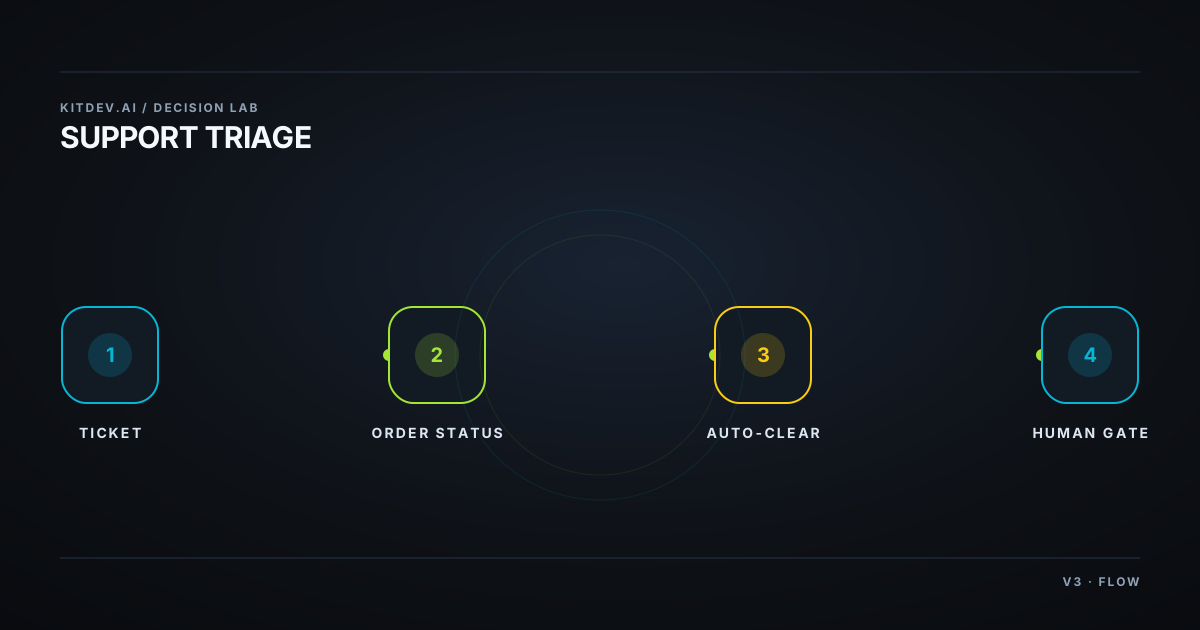
AI for E-commerce: Where It Pays and Where It Doesn't
AI for small e-commerce: support triage, product copy and order updates, with real 2026 pricing and the per-resolution math that decides when it actually pays.
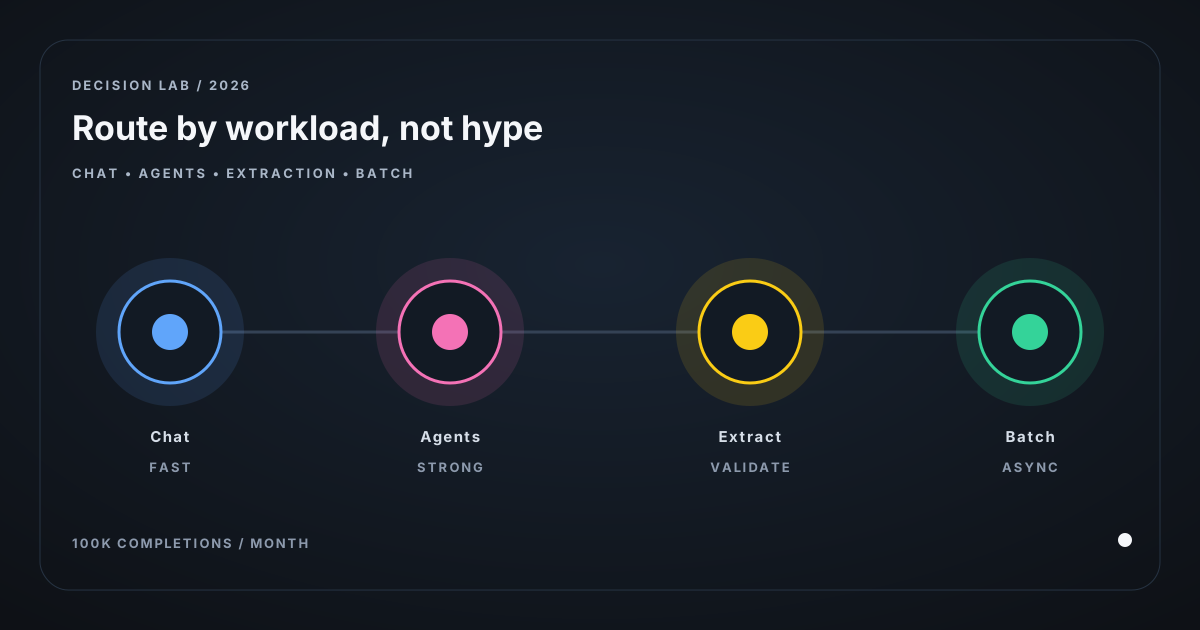
LLM API Pricing for a Micro-SaaS: Price the Workload
Price LLM APIs by successful workflow, using dated token rates, a 100,000-completion cost fixture, batch discounts, and explicit self-hosting limits.
Get the next verdict before it's everywhere.
One email when a new lab post or cost table ships. No spam, no confirmation step — unsubscribe anytime.