DeepSeek-V4.1-Flash on One 96GB GPU: 1M Context, Measured
We ran 763B DeepSeek-V4.1-Flash at 1M context on one 96GB Blackwell card with Strata. Measured speed, memory fit, tool calls, failure modes and when to skip it.
Filed under Local LLM Inference· see every report on this topic
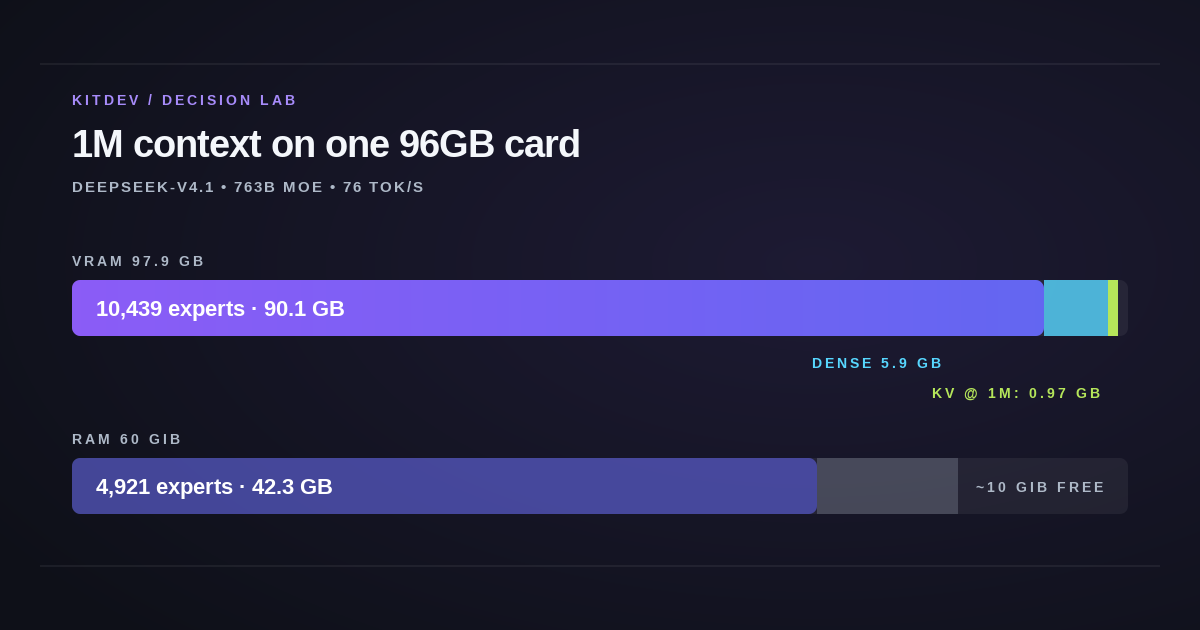
Verdict. If you run agents on one 96GB Blackwell card with at least 60 GiB of RAM, add DeepSeek-V4.1-Flash on Strata as a second lane for long-context, tool-heavy work. Don’t replace a fast 27B model with it: it generated 76 tok/s against Qwen’s 115, and read cold prompts 4–5× slower.
This is a follow-up to our 96GB Blackwell field guide for Qwen3.8-27B. Same box, same agent stack, a much bigger model. The question was whether a 763B mixture-of-experts model can do real agent work at its full 1M-token context on one workstation GPU, and what it costs in speed and memory. Every figure below was measured on 25 October 2026 unless it links to an outside source.
The operator and the leak: one workstation, two jobs
The operator is a one-person AI tooling shop running coding and ops agents (Hermes, OpenCode, and a GBrain knowledge server over MCP) against a local OpenAI-compatible endpoint. The machine is a Ryzen 9 7950X with 60 GiB of DDR5, a Samsung 990 PRO NVMe and one RTX PRO 6000 Blackwell Max-Q (96 GB, power limit at its 325 W maximum).
The leak was context. Qwen3.8-27B is fast, but its 262K window forces agents to compress or drop history on long repository and log-reading jobs. Those jobs were spilling to paid cloud models. The decision: can a frontier-class MoE run locally at 1M context, well enough to keep those jobs on the box?
How a 763B model fits in 96GB of VRAM
Only a small slice of the model is active per token. DeepSeek-V4.1-Flash-1017 routes each token through 6 of 384 experts per layer. An engine can keep the most-used experts on the GPU, park the rest in system RAM, and still decode at usable speed.
We used ISTA’s GSQ-RCO IQ2_XXS build (MIT): 2.00 bits per weight, 138 GB in four shards, plus a separate 111 GB Engram n-gram table that the engine reads from NVMe. ISTA’s model card reports that this build matches the base model on AIME25, GPQA-Diamond and LiveCodeBench v6 at reasoning effort 50. We did not re-run those benchmarks.
This is where the model landed at load, with the full 1M context reserved:
| Memory pool | What lives there | Size |
|---|---|---|
| VRAM (97.9 GB card) | 10,439 of 15,360 routed experts | 90.1 GB |
| VRAM | Dense weights | 5.9 GB |
| VRAM | KV cache for 1,048,576 tokens | 0.97 GB |
| System RAM (60 GiB) | 4,921 routed experts | 42.3 GB |
| System RAM | OS and services, ~10 GiB left free | ~8 GB |
(Source: Strata’s load log and free -g, 25 October 2026.) The experts take almost everything. VRAM ends with about 0.56 GB spare, and the Engram table streams from NVMe through the page cache.
The KV cache is the surprise. V4.1 keeps a 128-token FP8 sliding window plus a compressed FP4 history, and attention reads at most 512 compressed rows per token. The engine reserves the whole 1M-token cache at startup, and on our box that took 0.97 GB. Long context costs prompt-reading time, not memory.
One warning to ignore: Strata’s planner prints “more than the model was trained on (256K)” above 256K. That text comes from its Qwen code path. DeepSeek’s config.json and the GGUF header both declare 1,048,576 tokens (YaRN factor 16 over a 65,536 base), and our needle test below confirms it.
Choosing an engine for DeepSeek-V4.1 on one GPU
We tested what could load this quant on one sm_120 card in October 2026. Only one engine passed every requirement.
| Engine | Verdict | Reason (Oct 2026) |
|---|---|---|
| Strata | chosen | Prebuilt sm_120 engine, official ISTA support, fit planner, OpenAI + Anthropic API |
| Project Maya | no | Upstream of Strata’s engine; its setup rejects the ISTA files |
| llama.cpp | later | V4.1 merged in b11870, but ISTA files need an unpublished patch |
| KTransformers, SGLang, vLLM | no | Need 400+ GB RAM or several GPUs for this model |
Strata was the only option that installed without sudo, checked its own downloads against SHA-256 pins, and ran a smoke test after packing the model. Its main limit is that it serves one request at a time. We ran Strata 0.2.4.2 with its DeepSeek engine strata-dsv41 0.1.51 (CUDA 13).
The visible workflow: download, pack, tune, test
The rollout had four steps, and the third changed the result most. Defaults left about a quarter of the generation speed on the table.
Download and pack
The download is ~249 GB from Hugging Face plus an 8 GB DSpark drafter. Run it in tmux, because an SSH drop otherwise kills a multi-hour job. Keep Xet on: with HF_HUB_DISABLE_XET=1 set, Hugging Face refused the 111 GB Engram file as “too large” on the regular path.
# prerequisites: Strata installed, ~260 GB free on NVMe, HF CLI with hf_xet
strata install -- --family deepseek41 --model IST-DAS-2.00bpw \
  --gguf-dir ~/models/DeepSeek-V4.1-Flash-GSQ-RCO-GGUF \
  --context 1048576 --port 8000 --host 0.0.0.0 \
  --api-key "$API_KEY" --vision no --no-browser --yes --no-start
# verify: the installer ends with a passing smoke test
Tune by A/B, not by defaults
We restarted the server for each variant, warmed it up, then measured generation and cold prompt reading. The script is about 120 lines of standard-library Python. Two settings mattered: the DSpark speculative drafter, and the prefill chunk size.
Each row is one fresh restart; the first is Strata’s default, and the bold row is what we run:
| Drafter · prefill chunk | Experts on GPU | Generation (tok/s) | Read 86K (tok/s) |
|---|---|---|---|
| auto · 4096 (default) | 9,995 | 60.8 | 1,334 |
| auto · 2048 | 10,052 | 64.3 | 1,166 |
| auto · 8192 | 9,885 | 64.5 | 1,686 |
| none · 4096 | 10,549 | 76.5 | 1,762 |
| none · 8192 (live) | 10,439 | 76.4 | 1,867 |
| none · 16384 | 10,215 | 62.1 | 1,828 |
(Mean of three 900-token generations and one cold ~86K prompt per variant, 25 October 2026.) Drafter off, chunk 8192 won: +26% generation and +40% prompt reading at 86K over Strata’s default. The drafter costs ~7 GB of VRAM. Without it, the planner fits about 550 more experts on the GPU, and on this card that beats speculative decoding. It is the same lesson as our MTP write-up, from the other direction: measure the drafter before you trust it.
Test it like an agent will use it
We ran a stdlib-only harness against the live config, with the same tests used earlier for the Qwen lane. The full suite passed 30 of 31; the one failure was the harness rejecting “HELLO! OVER.” for trailing punctuation, and the test now strips it.
| Measure (25 Oct 2026) | DeepSeek-V4.1 | Qwen3.8-27B |
|---|---|---|
| Generation, long outputs (tok/s) | 60–77 | ~115 |
| Cold prompt reading at 27K / 86K (tok/s) | 1,552 / 1,867 | 7,800–9,400 |
| Cached 20K prompt, cold → warm (s) | 10 → 0.1 | 3.0 → 0.2 |
| Tool-call suite / 10× reliability | 11/11 · 10/10 | 11/11 |
| Context window (tokens) | 1,048,576 | 262,144 |
Qwen wins raw speed, which matches our earlier Qwen field guide. DeepSeek wins on what a single prompt can hold. The tool suite included streamed and parallel calls, a reasoning round trip, and a request declaring 120 tools.
Long context held up. A planted fact was found 17 times out of 17, at 6K to 203K tokens and 10/50/90% depth, then at 406K, and finally in a 940,501-token prompt. That last prompt took 712.6 seconds to read cold. A 256K follow-up question then took 191 seconds cold and 1.0 second warm, because the prefix cache kept the prompt.
Wire the agents, then add a lane switch
Both models serve on the same port, so a single script flips between them: stop one engine, start the other, wait for health, and swap the agent settings. Measured switch times were 117 s to Qwen and 218 s back to DeepSeek.
Agent settings matter more than with Qwen, because DeepSeek serves one request at a time. In Hermes we moved the 22 small side tasks (titles, summaries, approvals) to a cloud model and capped sub-agents at two. Long conversations compress at 150K tokens. OpenCode needs interleaved: {"field": "reasoning_content"} on the provider, or DeepSeek tool loops return HTTP 400. Through Hermes, a GBrain MCP tool call finished in 10 seconds on a warm 15.6K-token system prompt.
This is the live Strata run config:
{
  "args": ["--max-context", "1048576", "--dspark", "none", "--prefill-chunk", "8192"],
  "max_queue": 6,
  "reasoning_effort": "low",
  "reasoning_budget_tokens": 8192,
  "sampling": { "temperature": 1.0, "top_p": 0.95 }
}
Failure modes we hit or measured
None of these stopped the rollout, but each one changes how you run the lane:
- RAM squeeze: with all 42.3 GB of CPU-side experts in RAM, about 10 GiB was left for everything else. ComfyUI and TTS must stop in this lane, so media work means switching back.
- One request at a time: Strata queues up to 6 and answers 429 beyond that. A client retry after a timeout throws away the half-read prompt and starts over, so set retries to 0 or 1 and timeouts to 15–30 minutes.
- Cold long prompts are slow: about 12 minutes for 940K tokens. Fine for one long repository read, bad for RAG that sends fresh documents every turn.
- Tool-call edge cases: Strata parses only tools declared in the request (Strata issue #3883), and tool names containing dots come back as text (#3995). We did not hit either with our tool set; if you do, our guide to fixing broken tool calls on self-hosted inference covers the diagnosis.
- Auth breaks monitoring: once an API key is set, the
/metricsroute in our build accepted only API keys, not the telemetry key. Prometheus got a dedicated key. - Misleading warnings: the 256K “trained on” warning above, and the Xet download refusal. Both cost time, and neither was a real limit.
When not to run DeepSeek-V4.1-Flash locally
Skip it if more than one person or agent needs the model at once. A 27B model on SGLang serves parallel requests, and this setup serves one. Skip it if your box has less than ~56 GB of RAM free for the engine: the CPU-side experts then spill to NVMe and generation drops.
Skip it too if most of your traffic is short prompts with fresh context, such as chat or retrieval over new documents each turn. Qwen-class models read those 4–5× faster. In that case the $0 move is to keep your fast lane and send the rare 300K+ job to a cloud API.
The 30-day test: keep, demote or drop
Run this before you make DeepSeek the default lane:
- Baseline: log one week of agent jobs on the Qwen lane: tasks completed, wall-clock per task, compressions per task, and jobs sent to cloud for context.
- Run: three weeks with DeepSeek as the default lane, with the same logging and the same agents.
- Measure: cloud fallbacks for context, tool-call failures per 100 calls, and median wall-clock per task.
- Decide on 25 November 2026: keep DeepSeek as default if cloud fallbacks fall by at least half and median task time grows less than 1.5×. Demote it to an on-demand lane if fallbacks fall but time grows more. Drop it if tool failures exceed 2 per 100 calls.
Bottom line on DeepSeek-V4.1-Flash on a 96GB GPU
DeepSeek-V4.1-Flash runs on one 96GB Blackwell card with Strata, at its full 1M context, with clean tool calls and 76 tok/s generation. It is the right second lane for long-context agent work if you have 60 GiB of RAM and one consumer of the model. Keep the faster 27B lane for everything parallel or short.
FAQs
Can DeepSeek-V4.1-Flash run on a single 96GB GPU?
Yes, with the ISTA IQ2_XXS quant and an expert-offloading engine. On our RTX PRO 6000 Blackwell with 60 GiB of RAM, Strata kept 10,439 of 15,360 routed experts in VRAM (90.1 GB), put 4,921 (42.3 GB) in system RAM, and read the 111 GB Engram table from NVMe. It generated about 76 tokens/s.
Does it really handle a 1M-token context on one card?
The model is natively 1,048,576 tokens and its compressed KV cache needed only 0.97 GB of VRAM at 1M. We found a planted fact in a 940,501-token prompt. The cost is time: reading that prompt cold took 712.6 seconds.
Is it faster than Qwen3.8-27B on the same GPU?
No. On the same harness, Qwen3.8-27B generated about 115 tokens/s and read cold prompts at 7,800 to 9,400 tokens/s, against about 76 and 1,550 to 1,870 for DeepSeek. Prefix caching closes most of the gap in agent loops, where follow-up turns took 0.7 to 0.9 seconds.
Which inference engine should I use for DeepSeek-V4.1-Flash on one GPU?
We chose Strata because it ships a prebuilt sm_120 engine with official ISTA support, a fit planner, and OpenAI plus Anthropic APIs. Project Maya would not accept the ISTA files, llama.cpp needed an unpublished patch for them, and KTransformers, SGLang and vLLM needed far more RAM or more GPUs.
Sources
- ISTA-DASLab/DeepSeek-V4.1-Flash-1017-GSQ-RCO-GGUF, model card (MIT), including the AIME25 / GPQA-D / LCB v6 claim.
- llama.cpp release b11870, the DeepSeek-V4.1 merge.
- Engine: Strata 0.2.4.2, DeepSeek engine
strata-dsv410.1.51 (CUDA 13). Upstream engine: Project Maya. - Measured: every speed, memory, needle and switch figure comes from our runs on 25 October 2026 on the hardware above. The record is
~/sysops/14-deepseek-v41-strata.mdon the workstation; test output is in~/llmtest/results/(llmtest.py,needle_1m.py,ab_matrix.py). - Earlier baseline on the same machine: 96GB Blackwell: SGLang NVFP4 + DFlash2 vs vLLM BF16, Measured. Related failure write-up: vLLM MTP: Faster Inference That Quietly Broke Tool Calls.
Related posts
vLLM MTP: Faster Inference That Quietly Broke Tool Calls
Multi-token prediction cut our latency, then quietly corrupted tool calls. What MTP does, how the failure presented, and the settings that made it safe again.
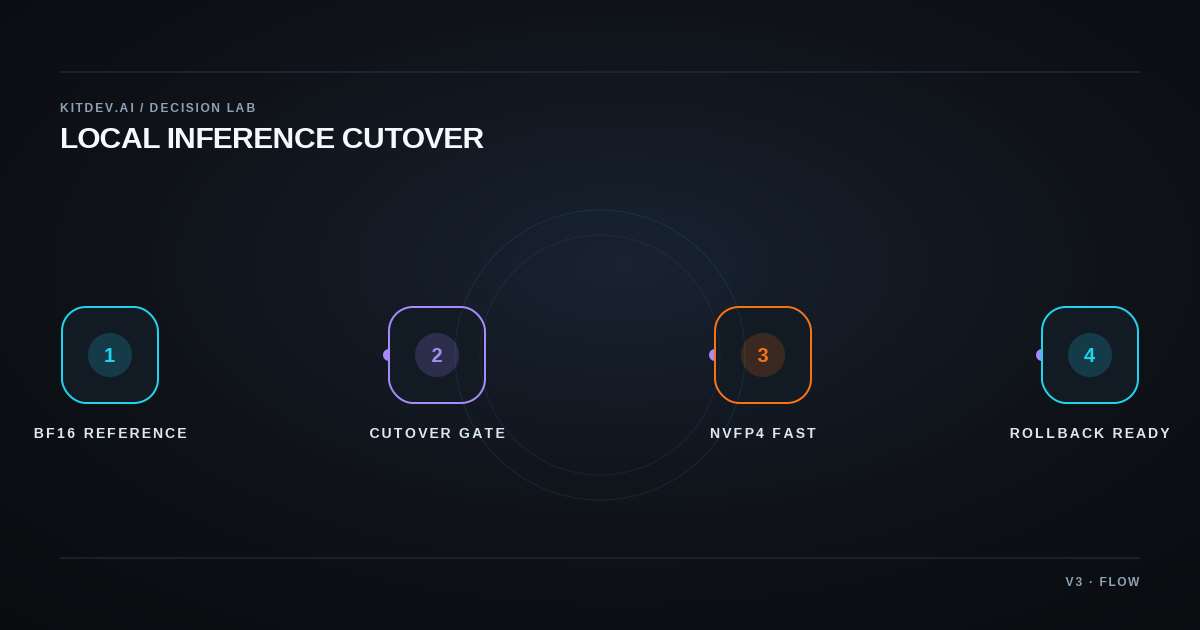
96GB Blackwell: SGLang NVFP4 + DFlash2 vs vLLM BF16, Measured
Measured Qwen3.8-27B serving on one 96GB Blackwell GPU: a BF16 vLLM baseline, an NVFP4 SGLang lane, and the throughput and latency that decide which holds.
Agent Memory Needs Typed Claims, Routing, and Maintenance
A three-month GBrain + Hermes run: why raw transcripts are not memory, and the typed-substrate, routing, and maintenance loop that made durable recall inspectable.
Get the next verdict before it's everywhere.
One email when a new lab post or cost table ships. No spam, no confirmation step — unsubscribe anytime.